Custer Companies Growth
Scaling a Complex Agribusiness: How The Custer Family Built a Diversified Business
Custer Companies operates across three interconnected, commercial agribusinesses: a grain and crop operation, a merchandising arm that trades commodities internationally, and a 40-truck transportation fleet built to solve a logistics problem no one else would solve for them.
Together, they form a vertically integrated agribusiness that spans production, trade, and logistics, which comes with a level of operational complexity that most lenders aren't equipped to finance.
For the Custer family, growing that complexity without losing control of it required a financial partner who understands agriculture as a business, not just a sector. That partner has been Compeer Financial.
Key Takeaways
- Custer Companies grew from a single grain and crop operation into three interconnected agribusinesses, each with its own cash flow cycle and capital needs.
- Diversification created financing complexity, including currency exposure in international trade and equipment financing for a growing fleet.
- Compeer Financial's agricultural expertise and flexible deal structuring gave the Custers the cash-flow predictability and capital structure needed to keep scaling on their own terms.
The Challenge: Growth that Outpaced a Single-business Financial Model
The business started with Custer Farms, a grain and crop operation. As it grew, the family added Wheaton Grain, a merchandising business co-owned by Jon Miller that buys, sells, and moves grain domestically and internationally, then Chippewa Valley Grain Transport, a trucking division built as a direct response to a bottleneck in the business.
"The trucking company was essentially built on the fact that it was hard to find trucks when we needed them," said Doug Custer. "If we couldn't get the product where it needed to go, we weren't going to be profitable. So, we decided to build our own solution."
That solution now runs close to 40 tractor-trailers hauling commodities nationwide, giving Custer Companies control over a critical link in its supply chain.
The expansion into international trade followed the same logic: spotting a gap in the agribusiness market and building toward it. "The growth was based on identifying profit centers like shipping internationally," said patriarch Ken Custer. "My dream was to somehow be in international business."
Through Wheaton Grain, the family now exports Wisconsin-grown crops to partners abroad, adding currency exposure, longer settlement cycles, and working-capital demands that look nothing like a traditional farm loan.
Three separate businesses created three cash flow cycles and risk profiles, which needed to be financed in a way that supports coordinated growth across the agribusiness—something agriculture lenders uniquely understand.
"The biggest thing that Compeer brought was the ag background," Doug said. "Sometimes when you're dealing with other financial institutions, just understanding the ebbs and flows can be difficult because it's not always the right time to sell just because you need the money. And you can't get in and out of the ag business where other businesses can."
The Approach: Industry Expertise and Flexible Deal Structuring
Understanding commercial financing nuances, rather than just the balance sheet, is what has shaped Compeer's approach to financing Custer Companies through its growth.
"One of the things that makes Compeer Financial unique is the knowledge of industry, the knowledge of credit, and the ability to help be a partner as businesses want to scale or when they have challenges," said Ty Rohloff, VP Commercial Financing at Compeer. "Compeer has a lot of tools available, unique ways to structure things and an appetite to learn new industries while really having a passion about the space."
That combination—sector knowledge, flexible structuring, and a long-term commitment to the business—is what turns a lender into a growth partner.
The Impact: Predictable Cash Flow and Room to Scale
"We were able to get some long-term rates locked in with Compeer. That has really helped our business and our cash flow, and overall, the relationship has been very good," said Doug Custer.
Locking in long-term rates also gave the Custers predictability. With grain merchandising margins and trucking fuel costs both subject to volatility, stabilizing the cost of capital freed up the business to focus on operational growth rather than rate risk.
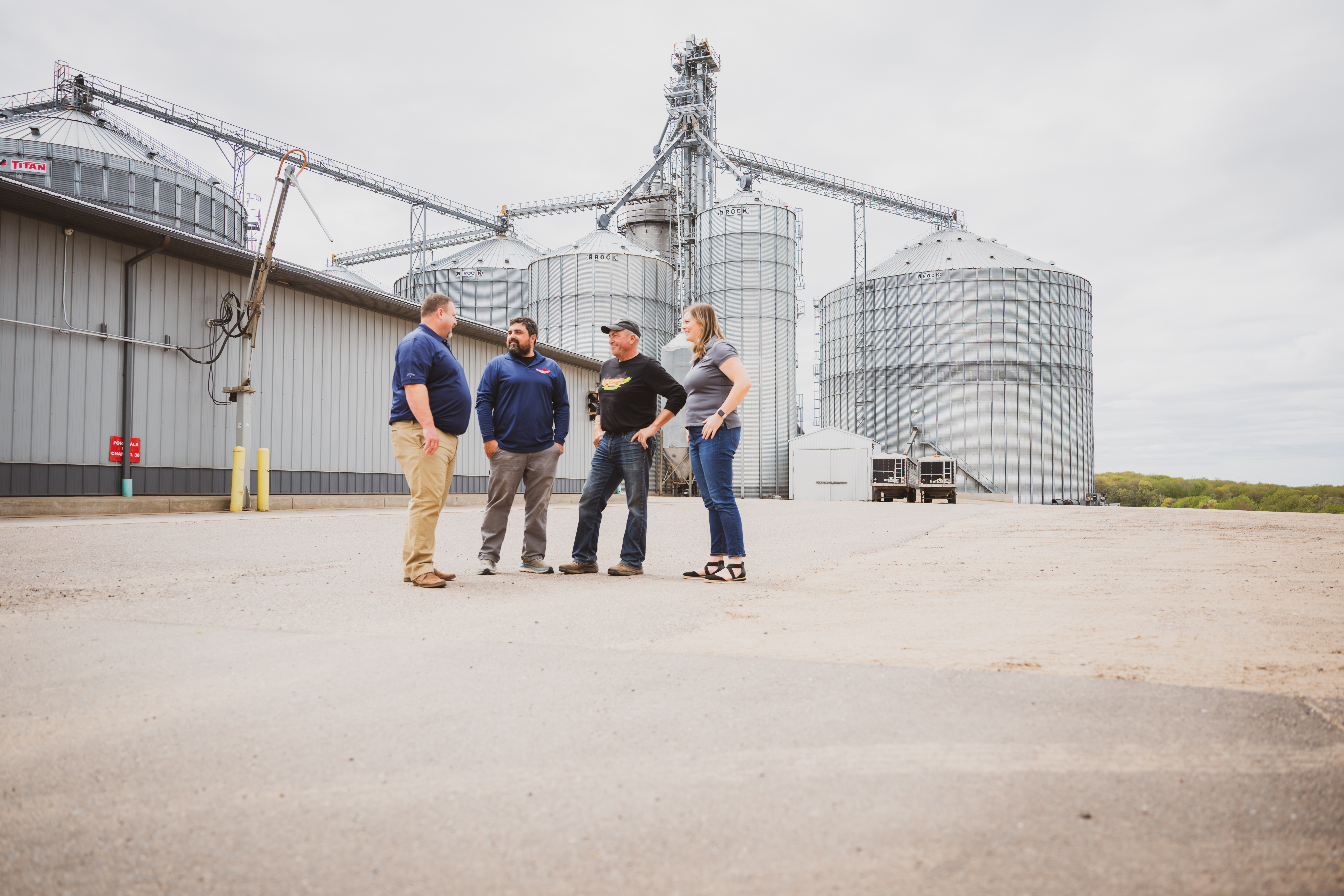
That stability shows up in governance as well; the Custers have kept their generational transition intentional, avoiding the succession pitfalls that often impact complex, multi-entity agribusinesses. "What we're looking at now and where we're going with this operation depends on the next generation," Ken said. "Doug and Darryl have to have that same opportunity I did."
That continuity matters to a financial partner, too; a lender backing a multi-generational, multi-entity operation is underwriting leadership stability, not just current cash flow. And that stability is what it takes to run three businesses across farming, merchandising and transportation, constantly balancing timing, market conditions and operational demands that don't always move in sync.
"Sometimes in this business, it's not just about the timing or the market," said Darryl Custer. "It's about staying disciplined, knowing when to move and when to hold back. Agriculture doesn't run on the same calendar as everything else."
That discipline, paired with a financing partner who understands its logic, has let Custer Companies keep growing on its own terms.


