Farm Loan Interest Rates: Refinance & Interest Rate Conversion

As interest rates shift, many farmers begin exploring ways to lower borrowing costs through farm loan refinancing.
For many borrowers, refinancing means reapplying for a loan they already have in place today — completing a new application, providing updated documentation and working through the approval process again.
At Compeer Financial, we recognize that many borrowers' primary goal is simply to secure a lower interest rate. That's why eligible member-owners may have access to interest rate conversion options, allowing them to adjust their interest rate without going through the full refinancing process.
Interest rate conversion is a feature not commonly available through many lenders, providing eligible Compeer member-owners with added flexibility as rates change.
This flexibility can help borrowers respond faster when market conditions change while avoiding unnecessary paperwork and disruption.
In this article, we’ll cover:
- What farm loan refinancing is
- What an interest rate conversion is
- Key differences between refinancing and conversion
- What impacts current farmland interest rates
- When each option may make sense
What Is Farm Loan Refinancing?
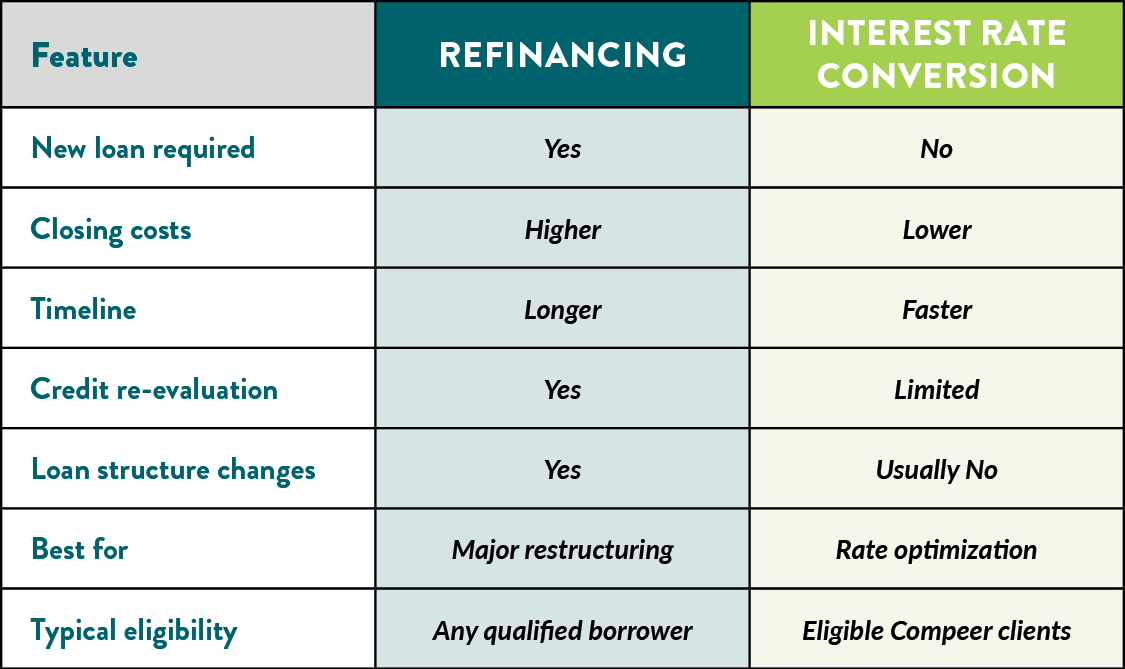
Farm loan refinancing is essentially reapplying for your loan. Borrowers replace their current loan with a new one that includes updated terms, interest rates or repayment structures.
Farmers refinance for many reasons, including:
- Securing a lower interest rate
- Improving cash flow
- Changing loan terms
- Consolidating debt
- Accessing equity in farmland or real estate
Several types of agricultural loans may be eligible for refinancing, including farmland loans, farm equipment and facility loans and farm operating loans.
Because refinancing creates a brand-new loan, it often requires a new application, credit review, updated documentation and potential appraisal or closing costs.
Refinancing can be a strong option when making major financial or operational changes — not just lowering your rate.
What Is an Interest Rate Conversion?
An interest rate conversion allows eligible borrowers to lower the interest rate on an existing loan while keeping the remainder of the loan structure in place.
Instead of refinancing into a new loan, you simply adjust the rate on your current loan.
That means:
- No new loan
- Less paperwork
- Lower costs
- Faster processing
- Minimal disruption to your operation
Not all lenders offer interest rate conversion options.
As a Farm Credit cooperative, Compeer Financial is built to support agriculture through changing market conditions. When interest rates move, eligible member-owners may have opportunities to convert to a lower rate without starting over.
For many borrowers, that can mean meaningful savings with a simpler process than traditional farm refinancing. Most rate conversions can be completed within one business day.
Additionally, eligible borrowers may have opportunities to switch between interest rate products. For example, a borrower with a three-year fixed-rate period may choose to convert into a fully fixed-rate product if market conditions align with their long-term goals and risk tolerance.
Current Farmland Interest Rates and What Impacts Them
Current farmland interest rates are influenced by several factors, including broader economic conditions, Federal Reserve policy and the financial profile of the borrower.
Factors that commonly impact farm loan interest rates include:
- Federal Reserve policy and bond market trends
- Midwest farmland values
- Credit history and financial strength
- Loan type and structure
- Loan term length
- Collateral quality and location
Farmland loan interest rates may also vary between operating loans, equipment financing and real estate loans.
Because rates can shift over time, many borrowers periodically review whether refinancing or interest rate conversion could improve their financial position.
Key Differences Between Refinancing and Interest Rate Conversion
When Should You Refinance a Farm Loan?
Farm loan refinancing may make sense when your goals extend beyond lowering your interest rate.
You may consider refinancing if you want to:
- Consolidate multiple loans
- Change your repayment structure
- Access equity for expansion
- Improve cash flow
- Move your financing to a lender focused on agriculture
Example Scenario:
A farmer planning to expand acreage refinanced several existing loans into one long-term farmland loan with a simplified payment structure and improved cash flow.
When Is an Interest Rate Conversion a Good Option?
An interest rate conversion may be a better fit when your primary goal is lowering your rate while keeping your current loan structure intact.
A conversion may make sense if:
- Interest rates have declined
- You are satisfied with the current term and maturity structure of your loan
- You want to avoid refinancing costs
- You prefer a faster, simpler process
At Compeer Financial, your financial officer closely monitors market conditions and may proactively discuss conversion opportunities when they could benefit your operation.
Example Scenario:
After rates declined, a borrower converted an existing farmland loan to a lower rate without refinancing, reducing interest expense while avoiding the time and cost of starting a new loan.
In addition, eligible borrowers may have access to a wide range of interest rate options, with the ability to lock in rates from one to 30 years and select payment structures that align with their operation's financial goals.
Why Compeer Financial Offers More Flexibility
Many lenders rely solely on refinancing when borrowers want to lower their interest rate.
At Compeer Financial, eligible member-owners may have access to interest rate conversion options designed specifically for agriculture.
That means you may be able to:
- Lower your rate without refinancing
- Avoid unnecessary costs
- Respond more quickly to changing market conditions
- Maintain your existing loan structure
- Switch between interest rate products as your needs and market conditions change
Because agriculture and rural lending are our sole focus, our team understands the financial cycles, market pressures and long-term planning needs unique to farmers, rural landowners and agricultural businesses.
Talk to a Compeer Financial Officer About Your Options
Every operation is different. The right choice depends on your financial goals, loan structure and long-term plans.
Whether you are exploring farm loan refinancing or wondering if an interest rate conversion could help lower your borrowing costs, our team can help you evaluate your options.
Borrowers must be current on loan obligations to qualify. Conversion fees can vary by loan product. Terms, conditions and programs are subject to change. Compeer Financial is an equal opportunity employer and provider, and an equal credit opportunity lender. © 2026 Compeer Financial, ACA. All Rights Reserved.
Farmland for Sale Near You
Looking for information on farms for sale near you? Check out local land parcel details, including tillable acreage and land values, with our Compeer Land Locator.
Farmland Investor
Our team has the agricultural expertise to help you make informed decisions for your portfolio.
Can You Afford This Farmland? Financial Fact…
Learn how to know if you can afford farmland. This guide covers key financial factors for buying a farm like owned land cost and debt, benchmarking and more.


