Swine Building Costs 2026: Planning for Higher Stability
Swine Building Costs 2026: Higher, Steadier and Reshaping Pork Facility Decisions
Over the past several years, pork producers have closely monitored swine building costs and interest rates — two of the most influential variables shaping capital investment decisions. Updated data through 2026 confirms what many producers are experiencing firsthand: while volatility has eased, both construction costs and interest rates remain historically elevated, fundamentally reshaping how new facilities are evaluated.
The updated analysis focuses on a standard 2,400-head wean-to-finish barn using the same assumptions applied in previous years: a 15-year term loan, 85 percent financing, strong borrower credit and Southern Minnesota and Northern Iowa cost averages. Costs include everything except land, while interest rates reflect adjustable pricing for above-average borrowers.
Loan Payments Reflect a Higher Baseline
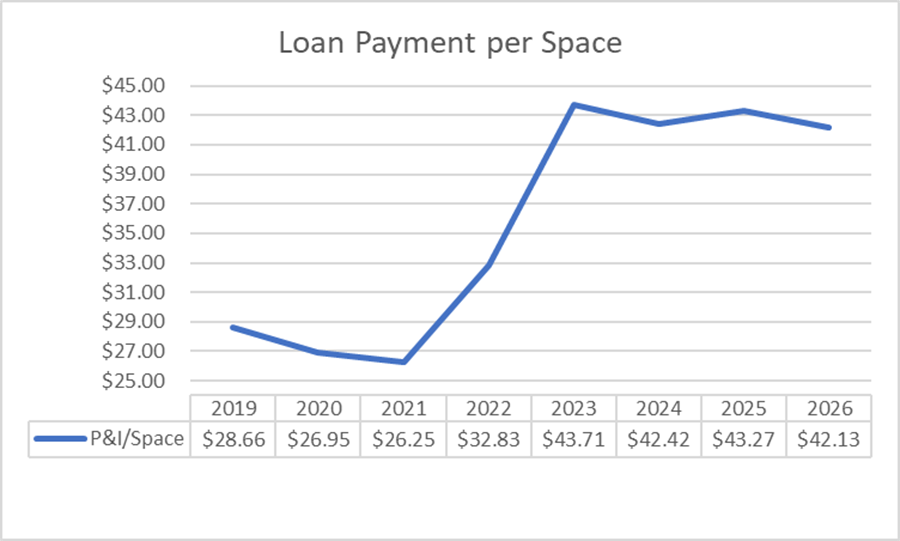
Chart 1 illustrates annual loan payment per pig space over time. After declining from 2019 through 2021, payments increased sharply in 2022 and peaked in 2023 as rising interest rates collided with record construction costs.
Since then, loan payments have leveled off in the low-to-mid $40 per space range. While modestly lower than the 2023 peak, they remain materially higher than pre-pandemic levels. That reality continues to influence how producers approach new construction, reinforcing a more disciplined, planning-driven mindset.
Building Costs and Interest Rates: Higher for Longer
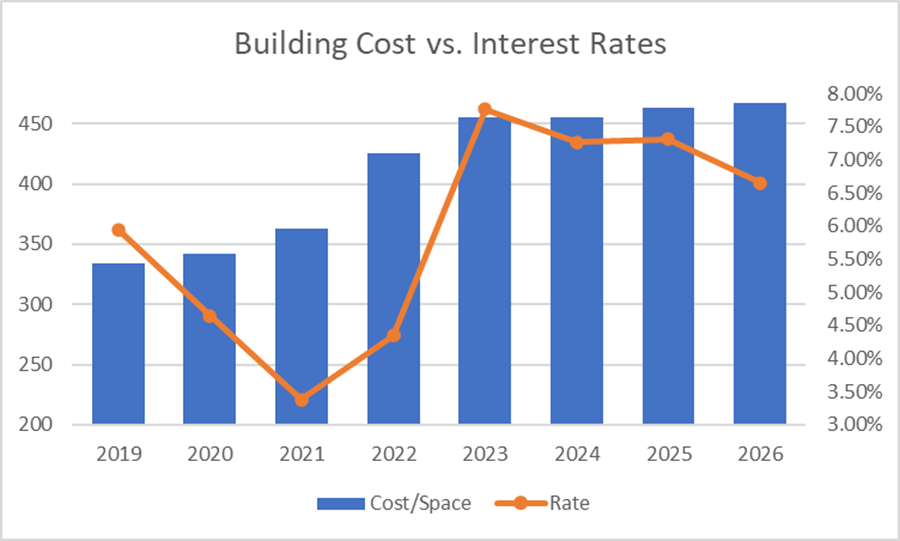
Chart 2 compares building cost per space with interest rates. Construction costs continue to edge higher, though at a much slower pace than the rapid escalation seen during the pandemic years. Labor availability, service-based trades and compliance-related upgrades remain persistent cost drivers.
At the same time, interest rates appear to have settled into a higher-for-longer range. After peaking in 2023, rates have moderated slightly but remain well above the ultra-low environment of 2020 and 2021.
From a pork industry perspective, this environment creates both pressure and opportunity. Margins remain cyclical and producers are increasingly prioritizing efficiency, herd health, labor savings and long-term site performance rather than focusing solely on expansion.
In many cases, new barns are justified not by adding capacity alone but by replacing older facilities that limit productivity, biosecurity or workforce retention.
Looking Beyond the Initial Cost
It is also important to consider the long-term benefits of well-planned swine facility investment. Manure nutrients continue to provide meaningful value to crop operations, modern barns tend to retain equity over time and depreciation remains an effective income management tool.
When viewed through a long-term lens, replacement and modernization decisions can support operational resilience even in a higher-cost environment.
Planning for Stability, Not Lower Prices
There are few indicators suggesting a return to significantly lower swine building costs or interest rates. Instead, today’s environment demands disciplined underwriting, realistic cash flow expectations and strategic decision-making.
While the numbers are higher, they are also more stable. For producers with strong operations and a long-term plan, that stability can still support sound investment decisions and position operations for the next cycle.
Talk with your Compeer swine specialist today to discuss how facility investment fits into your broader capital planning and long-term risk management strategy.